Microsoft expands its AI strategy: from a quantum chip to a virtual employee
Artificial intelligence (AI) is gradually moving from the position of a supplementary tool to the center of the technological strategies of major companies. Microsoft’s latest steps show that it does not want to use AI only in software, but also in the development of new computing technologies, devices, and business solutions that may change the way companies work.
Investors believe in the technological direction
From an investment perspective, Microsoft confirms that its long-term technological orientation is also reflected in the performance of its shares. Over the past five years, as of 2 June 2026, the company’s shares increased by 190.52%*, indicating strong investor confidence in its ability to develop cloud services, artificial intelligence, and enterprise software. The latest innovations therefore do not appear to be isolated experiments, but part of a broader strategy in which Microsoft is trying to move AI into multiple levels of its business.
Five-year performance of Microsoft Corp shares [USD]*
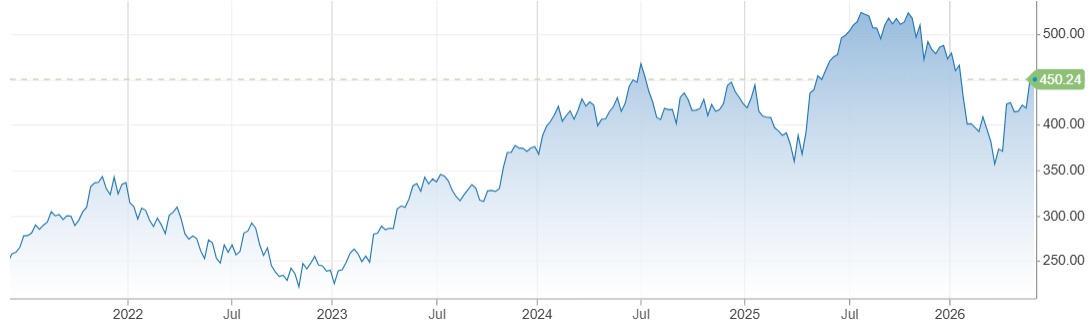
(Source: CNBC)
Majorana 2 advances quantum ambitions
One of the most prominent innovations is the Majorana 2 quantum chip, which, according to Microsoft, was also created with the help of artificial intelligence and is intended to bring the company closer to commercially usable quantum computers by 2029. The chip differs from competing solutions through the use of lead instead of aluminum superconducting wires, which is said to have delivered up to a 1,000-fold improvement in certain performance parameters. Microsoft is thereby strengthening its ambitions in the competition with IBM, Google, Amazon, and Chinese projects, but its approach is also facing criticism from scientists at the University of St Andrews in Scotland due to the lack of publicly available data for independent verification of the claims.
Solara connects mobility and AI
While the quantum chip demonstrates Microsoft’s ambitions in computing infrastructure, Project Solara is more focused on the practical use of artificial intelligence in the corporate environment. It is a new platform for mobile devices through which users are expected to communicate primarily using AI agents. Microsoft presented it at the Build conference in San Francisco together with two concept designs developed in cooperation with Qualcomm and MediaTek.
Devices tailored to work tasks
The first concept resembles an employee badge with wireless connectivity, a touchscreen, and a fingerprint reader. The second is a small desktop unit with a screen that resembles smart speakers with displays. According to Microsoft and Qualcomm, similar devices may be better suited to specific work situations than traditional computers or smartphones because they will allow specialized AI agents to run directly in a particular environment. AccuWeather, Best Buy, CVS Health, and Levi Strauss are also involved in the development of the technology.
Scout as a virtual employee
The new AI assistant Scout also builds on the practical use of artificial intelligence and is intended to function as an autonomous virtual employee in corporate systems. Unlike ChatGPT or Copilot, it is not supposed to be tied only to a single user, but to act as an independent entity in internal emails and calendars. Thanks to this, it can help across the organization, for example by resolving schedule conflicts, rescheduling meetings, or answering colleagues’ questions.
Microsoft builds on a broader AI vision
Overall, Microsoft shows that its approach to artificial intelligence extends beyond a single product or service. The company is trying to build a broader ecosystem in which AI is connected with computing infrastructure, new devices, and everyday business processes. For investors, the key question will be whether these technological ambitions gradually translate into sustainable growth, greater adoption of paid solutions, and a further strengthening of the company’s competitive position.
Warning! This marketing material is not and must not be understood as investment advice. Data relating to the past are not a guarantee of future returns. Investing in a foreign currency may affect returns as a result of fluctuations. All securities transactions may result in both profits and losses. Forward-looking statements represent assumptions and current expectations that may not be accurate, or are based on the current economic environment, which may change. ETFobchodník is a trading brand of CAPITAL MARKETS, o.c.p., a.s., regulated by the National Bank of Slovakia
* Data relating to the past are not a guarantee of future returns.
Sources:
Topics
CAPITAL MARKETS, o.c.p., a.s. is an investment firm (securities dealer) pursuant to Section 55(1) of Act No. 566/2001 Coll. on Securities and Investment Services and on Amendments and Supplements to Certain Acts, as amended (hereinafter referred to as the Securities Act). By Decision of the National Bank of Slovakia No. OPK-2297/2007-PLP dated 30 October 2007, CAPITAL MARKETS, o.c.p., a.s. was granted an authorization to provide investment services within the meaning of Section 54(2) in conjunction with Section 59(2) and (3) of the Securities Act, which, in accordance with the provisions of the Securities Act, was extended by Decision No. OPK-1830/2008-PLP dated 21 April 2008, Decision No. OPK-11601-1/2008 dated 28 January 2009, Decision No. ODT-5059-3/2012 dated 23 July 2012, and Decision No. ODT-9332/2014-1 dated 21 October 2014.
Related articles
Show allSpaceX Is Targeting the $3 Trillion Mark. Can the Newcomer Defend Its Giant Valuation?
SpaceX’s stock market debut became one of the most closely watched events in the technology sector a...
TSMC advances the chip industry while addressing pressure on efficiency
Semiconductors are among the fundamental pillars of technological transformation today, and their im...
Snowflake benefits from data, artificial intelligence, and its agreement with AWS
Artificial intelligence (AI) is increasingly changing the way companies work with data. In this envi...