
TSMC advances the chip industry while addressing pressure on efficiency
Semiconductors are among the fundamental pillars of technological transformation today, and their importance is growing as the demands placed on computing performance, data centers, and modern digital solutions increase. For chip manufacturers, this means not only strong customer demand, but also the need to find a way to manage further technological progress efficiently, in a cost-sustainable manner, and with regard to rising energy consumption.
Share price growth brings expectations
One of the most prominent players in the technology sector is the Taiwanese manufacturer of semiconductor chips and integrated circuits, which play a key role in the development of artificial intelligence and the operation of data centers. The company’s strong position, under the leadership of Che-Chia Wei, is also confirmed by the performance of its shares. Over the past five years, as of 4 June 2026, their price increased by an extraordinary 1,790%, making the company one of the most striking growth stories in the technology market.
Five-year performance of TSMC shares [USD]*
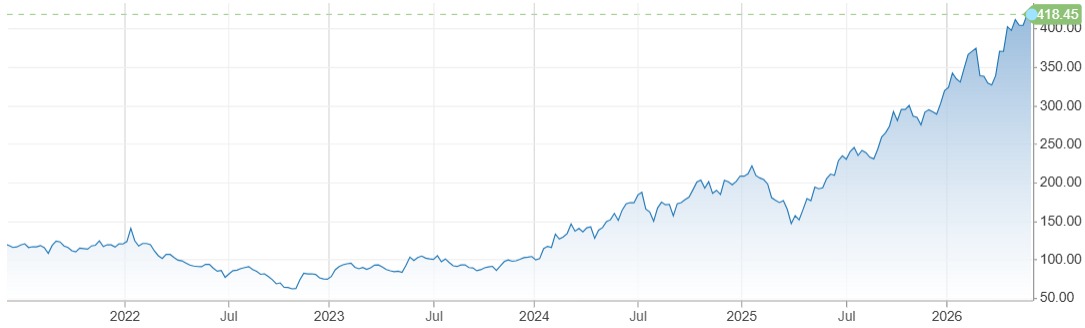
(Source: CNBC)
Arizona will strengthen chip capacity
Growing demand for computing performance supports TSMC’s optimistic outlook, as the wider use of artificial intelligence increases the need for advanced semiconductors. Company head C. C. Wei indicated that he would like to increase chip prices, but emphasized that the company wants to proceed sustainably, not abruptly. The strategy also includes expansion outside Taiwan, with TSMC investing 165 billion USD in new factories in Arizona, although fully covering the needs of US customers with production in the USA will still take a very long time. At the same time, the company does not yet plan to deploy expensive High-NA EUV machines in regular production until it becomes economically advantageous. TSMC therefore remains a key link in the global AI supply chain, but its position is also accompanied by geopolitical risk related to tensions between China and Taiwan.
Semiconductor production is becoming more efficient
While growing demand increases pressure on capacity, chip production is also advancing technologically. NVIDIA and TSMC are deepening their cooperation in the use of artificial intelligence and accelerated computing in semiconductor design and manufacturing, from computational lithography and materials simulation to process analysis, factory planning, and defect inspection. The NVIDIA cuLitho tool is expected to deliver a 20-50% improvement in cost efficiency or cycle time, while cuEST enables chemical simulations up to 50 times faster. TSMC also uses NVIDIA H200 graphics processors to optimize factory operations and is exploring the Omniverse platform in the development of the FabTwin virtual manufacturing environment. The aim is to accelerate, refine, and streamline chip production using AI directly in factories.
Performance runs into energy consumption
As performance grows, energy consumption is becoming an increasingly important challenge. TSMC points out that customers ranging from smartphone manufacturers to AI data centers require higher performance without a significant increase in energy demands, as electricity is becoming an increasingly important cost and capacity constraint. Chip development therefore focuses not only on shrinking circuits, but also on more efficient solutions such as advanced packaging, chip stacking, and photonics. TSMC expects to reduce energy consumption by up to 30% and simultaneously increase computing performance by more than 20% between N2 technology and the A14 generation planned for 2028. The future of semiconductors will therefore depend not only on higher performance, but also on its more efficient use.
TSMC seeks sustainable growth
TSMC thus stands at the center of a story that connects the growth of artificial intelligence, technological innovation, and the new limits of the semiconductor industry. For investors, the key question remains whether the company can transform strong demand into long-term sustainable growth while managing pressure on capacity, costs, energy efficiency, and geopolitical risks. The future of the chip sector will therefore depend not only on who can produce the highest-performing solutions, but also on who can manufacture them efficiently, reliably, and on a sufficient scale.
Warning! This marketing material is not and must not be understood as investment advice. Data relating to the past are not a guarantee of future returns. Investing in a foreign currency may affect returns as a result of fluctuations. All securities transactions may result in both profits and losses. Forward-looking statements represent assumptions and current expectations that may not be accurate, or are based on the current economic environment, which may change. ETFobchodník is a trading brand of CAPITAL MARKETS, o.c.p., a.s., regulated by the National Bank of Slovakia
* Data relating to the past are not a guarantee of future returns.
Sources:
Topics
CAPITAL MARKETS, o.c.p., a.s. is an investment firm (securities dealer) pursuant to Section 55(1) of Act No. 566/2001 Coll. on Securities and Investment Services and on Amendments and Supplements to Certain Acts, as amended (hereinafter referred to as the Securities Act). By Decision of the National Bank of Slovakia No. OPK-2297/2007-PLP dated 30 October 2007, CAPITAL MARKETS, o.c.p., a.s. was granted an authorization to provide investment services within the meaning of Section 54(2) in conjunction with Section 59(2) and (3) of the Securities Act, which, in accordance with the provisions of the Securities Act, was extended by Decision No. OPK-1830/2008-PLP dated 21 April 2008, Decision No. OPK-11601-1/2008 dated 28 January 2009, Decision No. ODT-5059-3/2012 dated 23 July 2012, and Decision No. ODT-9332/2014-1 dated 21 October 2014.
Related articles
Show allSpaceX Is Targeting the $3 Trillion Mark. Can the Newcomer Defend Its Giant Valuation?
SpaceX’s stock market debut became one of the most closely watched events in the technology sector a...
Microsoft expands its AI strategy: from a quantum chip to a virtual employee
Artificial intelligence (AI) is gradually moving from the position of a supplementary tool to the ce...
Snowflake benefits from data, artificial intelligence, and its agreement with AWS
Artificial intelligence (AI) is increasingly changing the way companies work with data. In this envi...